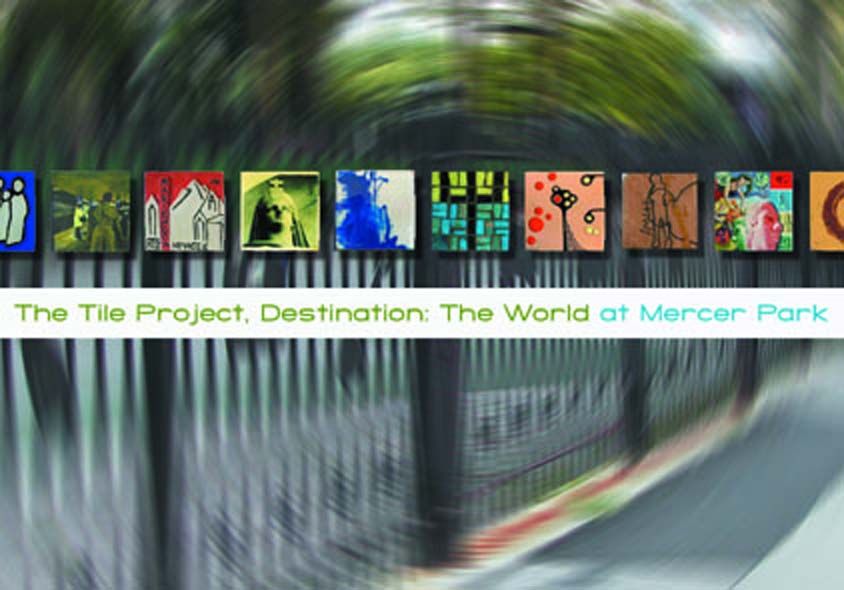
Design Credit: Kim Sillen Gledhill
The Tile Project, Destination: The World
40 nations,
22 sites,
+ 100+ tiles
1 goal: to unite the world.
Between 2004 and 2026, over 100 artists came together to create 22 permanent art works – each consisting of tiles made by The Tile Project’s participating artists — including those from countries in conflict with one another. These works, thus, demonstrated that artists can unite the world in ways that are respectful, tolerant and understanding of the global communities’ differences and commonalities.
Tiles were chosen, because as the architect Stanley Tigerman once said, “they are the essence of what public art has the potential to be – an art form that can be found anywhere in the world by anyone, no matter one’s class, race, age or gender, with a purpose and beauty transcending all differences between all people. A tile is a measurable unit of our humanity; it is one of many. Since their origin over 8,000 years ago in Ancient Egypt, tiles have served not only a practical function in private homes, public fountains and plazas, palaces, cathedrals, parks, trains and subway stations throughout the world, but they have also been one of the most enduring markers of cultural history.”
Additionally, the project is an example of globalization at its best: The contact (lead) artist at each installation site received a set of tiles, donated by the 100 participating artists. The lead artists, then, were free to design the form in which the tiles were united. As such, the resulting installations are sensitive to each site’s cultural, artistic and physical contexts. In this way no single vision was imposed upon any of the artists or their countries’ unique needs.
In addition, thanks to Virginia Ilg, the project included a K-12 and university component in which K-12 students exchanged paper tiles (drawings and letters) and university students contributed to an exchange of works.
The Tile Project also included a catalog of all the works, produced thanks to Boston Schoolyard Funders Collaborative and Open Society Institute and Soros Foundation Network.
This project grew out of Mary Sherman’s residency at MIT working with Alex Slocum’s class Pathways to Peace and MIT’s Glass Lab, with special thanks to Peter Houk and Seattle’s Pilchuck Artist-in-Residence program, where Mary was a resident. At Pilchuck, she produced glass tiles for her contribution to various global sites. In addition, she designed the installation of tiles in Boston, Washington DC, and New York (which later was permanently installed in Toronto with the assistance of Dyan Marie).
An extensive archive of the project, including a list of each of the project sites, the artists who participated, the press received, the associated education component and more can be found on TransCultural Exchange’s web portal for The Tile Project, Destination: The World.